Say it.
It's on the record.
An invoice, a payment, a card statement. Say what happened and it's in your books, checked against rules that refuse a guess. In the cloud with Claude, or entirely on your Mac.
The demo gives you private example books to poke at. Free, open source, and your books export any day.
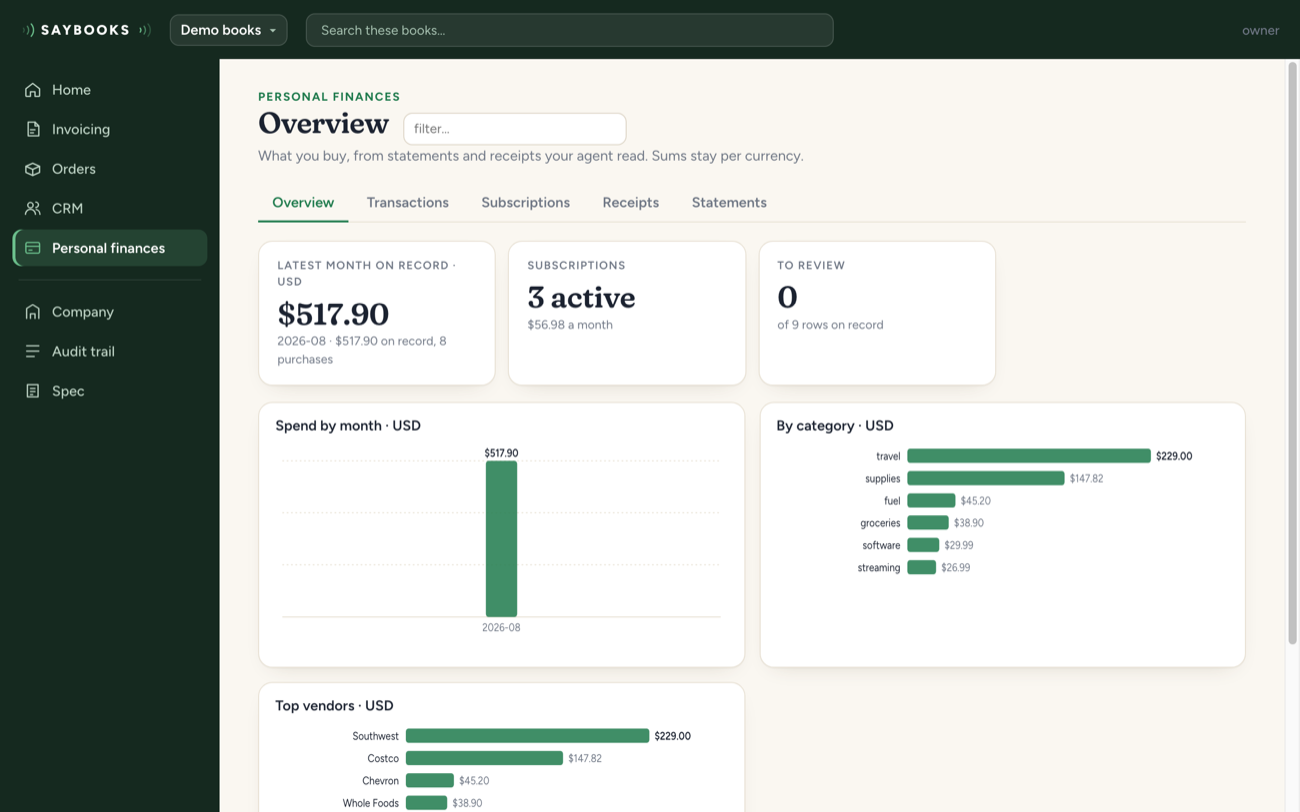
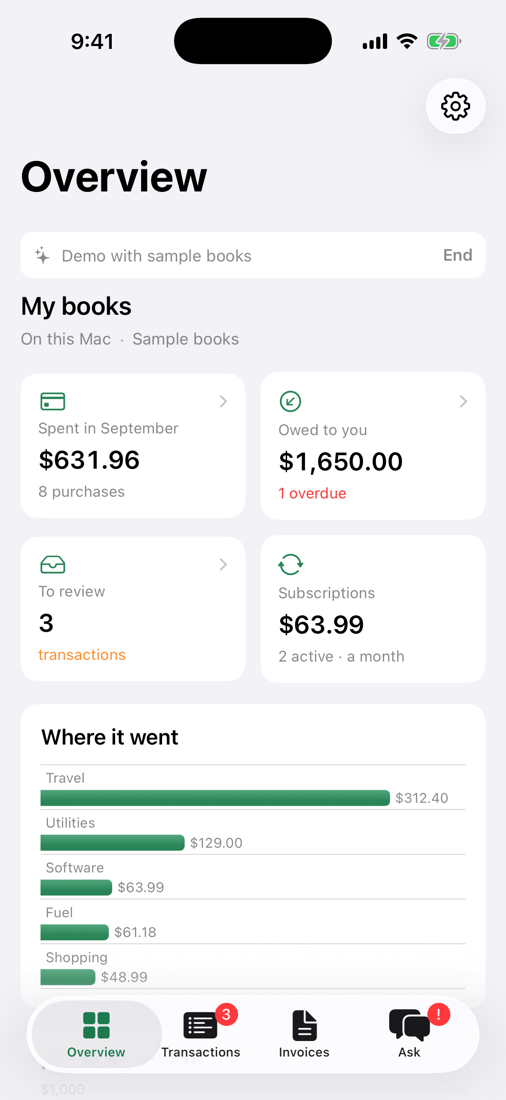
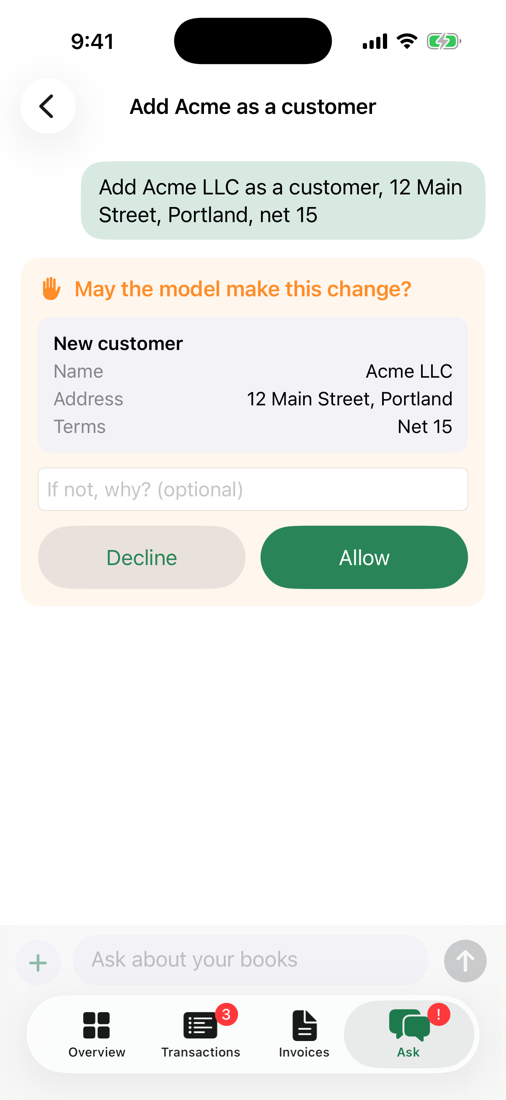
Two homes for the same books
Same books, same rules, same record. The only question is where they sit, and you can change your mind later.
With the assistant you already use
Add Saybooks to Claude as a connector and talk. Your books live on saybooks.io, and you can open them in any browser.
- Nothing to install. Sign in with Google and start.
- Works with Claude, and with any assistant that speaks MCP.
- Invite your bookkeeper or a partner, each with their own role.
- Free. There is no paid plan yet.
On your Mac, and nowhere else
The books, your documents and the model that reads them all stay on your Mac. Your iPhone asks from anywhere.
- A model runs on the Mac itself. What you type never reaches an AI company.
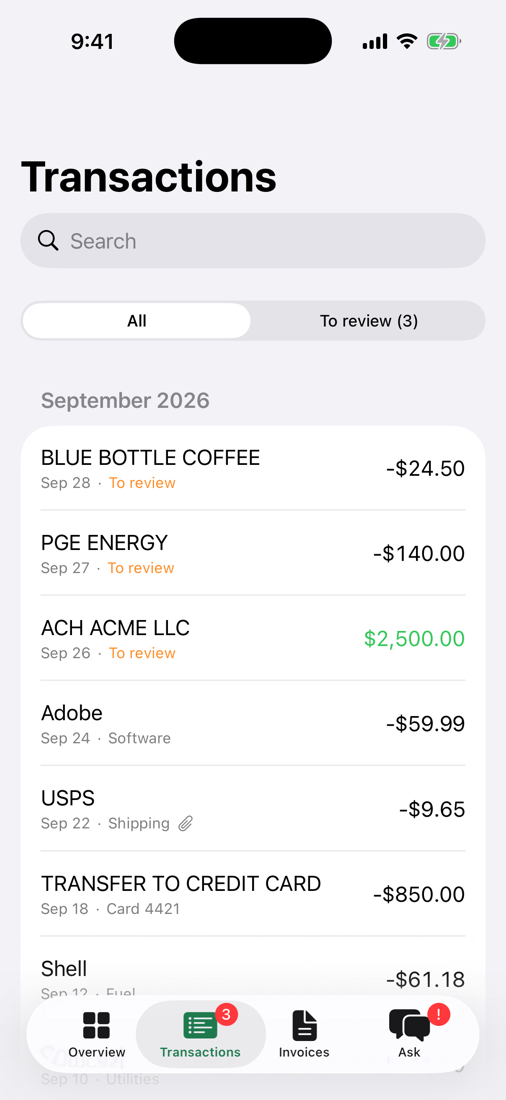
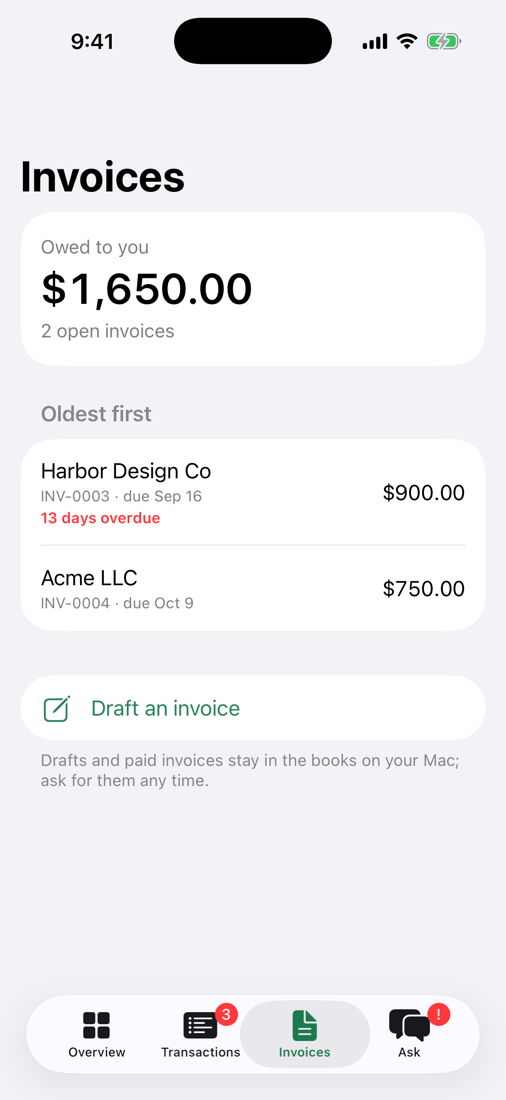
- Ask questions, see your spending and invoices, and snap receipts from your iPhone.
- Phone and Mac talk through your own iCloud, sealed. Apple carries it and cannot open it.
- Nothing changes in your books until you tap Allow.
Your books in your pocket, your Mac doing the work
Pair your iPhone with the Mac once, by scanning a code. Then ask a question from anywhere, see where the money went, open an invoice's PDF, or photograph a receipt. When the model wants to change something, the phone asks you first.
- Sealed end to end. Messages travel through your own iCloud account. Apple carries them and cannot open them.
- Your Mac stays in charge. The model and the books never leave it; the phone shows what the Mac sends.
- Nothing changes until you allow it. Every change waits for your Allow, with the numbers in words.
Helpful is not the same as right
Most AI tools fill a gap with a guess and call it done. Here the rules live in the books, not in the prompt, so they hold whichever model is talking.
This is a real exchange. The invoice went out; the change to it was refused, and the model said so instead of pretending.
Every line came from the system, refusal included. Read a full session
It gets told no
Every rule applies to the agent exactly as it applies to you. A refusal is one plain sentence with the numbers in it. Nobody talks their way around it; somebody changes the facts.
Every act on the record
Who did it, a person or an agent, what, when, and why. Refusals sit next to the acts that went through. Read the whole history, export all of it, or delete everything.
Some acts are yours alone
An agent can judge every row of a bought list. Only a person promotes one into the real list, sets what a campaign may claim, or marks a message as sent.
Issued means issued
An issued invoice never changes; a mistake is a void with a reason and a fresh number. Statements land whole or not at all, reconciled to the printed balances. Receipts must add up to their own lines.
Six things people actually say
Say the sentence, or click the button. It is the same act either way.
Invoice a client
A numbered invoice, a link and a PDF. Any currency, your tax scheme. Who paid, who hasn't.
"Invoice Meridian for the March consulting, $4,250, net 30."Start invoicing → AnyoneRead a card statement
Every row lands with the printed balances, whole or not at all. Then: what am I paying for every month?
"Here's my September statement. What am I subscribed to?"See it in the demo → Open to workTrack a job hunt
Postings, applications, interviews, recruiters. It catches the same job reaching you twice.
"The recruiter called. Interview Thursday at 2."Start tracking → Small businessesRun order to cash
Quotes, orders, shipments, invoices, payments, and a credit limit the agent cannot talk past.
"Receive 20 Widget B and finish Northwind's order."Explore → SalesKeep the list honest
Accounts with sources, a bought list the agent judges and you promote, drafts you send yourself.
"Tell me which rows of the Phoenix list are worth my time."Explore → Anyone with an accountantSee how the quarter went
A preliminary profit and loss and balance sheet, then the month as a QuickBooks Online or Xero file for the accountant.
"How did we do last quarter?"How the hand-over works →